Pickleball is well established in Costa Rica, and it keeps growing. The sport is concentrated on the country’s Pacific side, across three primary regions: Guanacaste’s Gold Coast in the northwest, the Central Pacific corridor around Jacó and Los Sueños, and, more sparsely, the Southern Zone.
Courts cluster where resorts, private clubs, and expat communities have invested in them, which is to say, along the coast rather than evenly across the country. A traveler who understands where that infrastructure lives and how to reach it will find the game readily.
This guide is written for the pickleball enthusiast weighing Costa Rica as a travel or lifestyle destination, not for someone booking a fixed itinerary.
What follows:
The sport’s momentum isn’t confined to Costa Rica. According to the Sports & Fitness Industry Association, 24.3 million Americans played pickleball in 2025, a figure that rose 171.8 percent between 2022 and 2025. Much of that enthusiasm now travels south with the players who feel it.
Where to Play Pickleball in Costa Rica: A Regional Overview
Court availability in Costa Rica is concentrated, not distributed. A handful of developed coastal areas and a slice of the Central Valley account for nearly all organized play; large stretches of the country have none at all. For the visiting player, this means the choice of region effectively determines the quality and frequency of play available.
Guanacaste, in the northwest, is the most mature pickleball region in the country. Its combination of expat density, sustained resort investment, and dependable dry-season weather has made towns such as Tamarindo, Playas del Coco, Playa Flamingo, and the Papagayo Peninsula the de facto center of the sport.
The Central Pacific corridor around Jaco and Los Suenos follows, with growth driven largely by gated residential and resort communities.
Beyond those two coasts, smaller pockets are emerging in the Central Valley expat corridor and the Southern Zone. They are worth noting for completeness, though they serve residents more than short-stay travelers.
Pickleball Guanacaste: The Gold Coast’s Growing Hub
Guanacaste’s stretch of Pacific shoreline, known locally as the Gold Coast, has become the country’s clearest pickleball hub. Tamarindo, Playas del Coco, Playa Flamingo, and the residential communities around the Papagayo Peninsula each host courts, and the reasons converge: a large and well-established U.S. expatriate population, a concentration of resorts willing to build and program courts as an amenity, and a long, reliable dry season that keeps outdoor play possible for months at a stretch.
Tamarindo, long a surf and lifestyle town with a deep expatriate community, has been an early adopter, and club and resort programs around Playas del Coco have followed.
The venues visitors will encounter tend to be resort pickleball programs and private club courts tied to residential developments rather than municipal facilities.
Pickleball Retirement Lifestyle: Why the Game Anchors Expat Communities
Costa Rica’s long-standing status as a retirement and residency destination now overlaps neatly with pickleball’s rise. For many who relocate, the game becomes a social and fitness anchor: a low-impact sport that’s easy to learn, forgiving on the joints, and, above all, sociable, which is precisely what a newcomer to a foreign community values most. It’s common for an expat’s first friendships in a new town to form on a court.
Developers have noticed. Gated communities and residential developments increasingly build courts as a lifestyle amenity aimed squarely at this demographic, recognizing that a pickleball program can do as much to sell a community as a pool or a clubhouse.
The result is a kind of feedback loop: courts draw residents who play, and their play makes the community more attractive to the next arrival. This is where the retirement-lifestyle thread and the luxury-community model begin to converge.
The Pickleball Luxury Community Model in Guanacaste
At the higher end, residential and resort communities in Guanacaste and the Central Pacific increasingly position pickleball as one element of a broader luxury amenity package, set alongside championship golf, marina access, and a private beach club rather than offered in isolation.
The court becomes part of a curated lifestyle rather than a standalone facility, and its quality tends to reflect that framing. Guanacaste’s parallel appeal as a destination for championship golf illustrates how these premium sports amenities cluster within the same communities.
This tier is distinct from public and resort day-access courts. It’s oriented toward owners, long-stay guests, and members, and access follows membership rather than a walk-up fee. For a discerning player who values privacy and consistency over convenience, it’s the model most likely to satisfy, and it’s where a named example is instructive.

Covered Pickleball Courts and Year-Round Play at Cantomar Ocean Club
A few minutes south of Playa Flamingo, at Playa Punta Pelencho, you’ll discover the covered pickleball courts at Cantomar Ocean Club. It is a small detail with outsized consequences in this climate: shade extends play through the hottest hours, and a covered court keeps a session going when a brief green-season shower passes overhead, neither of which holds true on the open courts that make up most of this coast.
The community around them is members-only, and its character explains a good deal about who has been drawn to Guanacaste lately. The residences are architecturally designed, with infinity-edge saltwater pools. Their beachfront lots sit within a rare 50-meter titled ocean setback, whereas most beachfront property in Costa Rica is set back 200 meters.
Personalized concierge service and on-site property management keep homes maintained while owners are away, turning a court a short walk from the front door into part of ordinary life rather than a holiday novelty.
Pickleball is one small part of daily life here, as you’ll see in our look at the Pura Vida lifestyle at Cantomar.
The Central Pacific – Los Suenos, Jaco, and Resort-Anchored Play
South of Guanacaste, the Central Pacific offers a different flavor of the same infrastructure. Here, the courts are anchored to the resort-and-marina ecosystem around Los Suenos and the nearby town of Jaco, where play is typically bundled into gated residential or resort communities rather than offered as a standalone public amenity.
The region’s practical advantage is proximity. Los Suenos sits roughly 90 minutes from San Jose’s international airport, a meaningful contrast to Guanacaste’s more remote courts, which are often served instead by the Liberia airport farther north. For a traveler weighing a shorter transfer against Guanacaste’s greater court density, that distance is worth factoring in early.
Beyond the Coast – Where Else Courts Are Emerging
Away from the Pacific beaches, two areas are worth naming. The Central Valley expat corridor around Escazú and Santa Ana, on the western edge of San Jose, has a growing base of residents and a handful of courts oriented toward them. In the Southern Zone, small communities such as Dominical and Ojochal are beginning to see courts appear as their expat populations mature.
Both are lower in density than the coastal hubs and are better understood as options for residents than as destinations for a short pickleball getaway. Their inclusion here is a matter of completeness: a player relocating to Costa Rica may well find the game where a short-stay visitor wouldn’t think to look.
Is there pickleball in Costa Rica?
Yes. Pickleball is well established and growing in Costa Rica, concentrated on the Pacific coast. The most developed region is Guanacaste’s Gold Coast, followed by the Central Pacific corridor around Jacó and Los Sueños, with smaller pockets in the Central Valley and Southern Zone. 
Resort Pickleball Amenities: What a Traveling Player Should Expect
A visiting player will encounter two dominant models in Costa Rica. The first is the hotel or resort program, where courts are offered as a guest amenity, sometimes open to any guest for a fee and sometimes bundled into the stay.
The second is the members-only private club, where courts belong to a residential community, and access runs through membership or resident sponsorship. Knowing which model a given property follows matters more than any single amenity, because it determines whether a player can simply show up.
In this context, “amenities” typically mean a specific set of things: court lighting that extends play into the early morning and evening hours, a pro shop or rental equipment, a resident pro or coach offering clinics or private lessons, an organized open-play schedule, and frequent pairing with tennis facilities on the same grounds.
The depth of these offerings varies widely; a full resort program with a coach and a clinic calendar sits at one end, and a single lined court with no staff sits at the other.
Pickleball Private Club Access: How Membership and Guest Play Work
At a members-only pickleball private club, access isn’t a matter of paying at a gate. Courts belong to the residential community they serve, and a visiting player generally reaches them through a member or resident who sponsors the visit. This might be an owner bringing a houseguest, for instance, or a long-stay renter whose lease conveys club privileges.
The practical difference from resort day-guest access is one of planning. While a resort court can often be arranged the morning of play, private club court time is best confirmed in advance, typically through a concierge or a community front desk, so that a sponsoring member is on record and a court is held. A traveler drawn to this tier should treat the arrangement as part of the trip’s logistics, not an assumption.
Tennis and Pickleball: Shared Courts and Converted Facilities
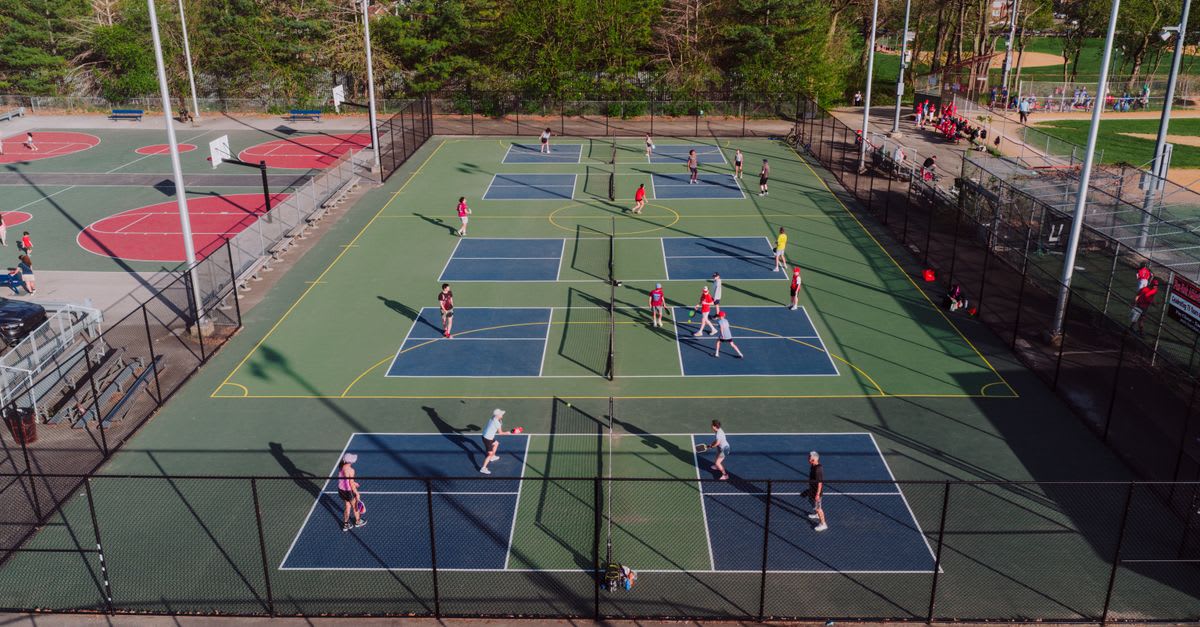
A recurring reality in Costa Rica is that many courts aren’t purpose-built. It’s common practice to convert or line an existing tennis court for pickleball rather than construct a dedicated facility, which means a single tennis court may host either sport depending on the hour and the net in use. For the player, this affects both the surface and the net height, since a tennis net set for tennis sits higher than a pickleball net and must be lowered or swapped for proper play.
Dedicated dual-line and purpose-built pickleball courts do exist, more often at newer resorts and higher-end residential communities that have incorporated pickleball into their plans from the start. Elsewhere, shared or converted courts remain the norm. A player who cares about consistent net height and true pickleball court dimensions should ask which arrangement a given venue offers before arriving.
All-Inclusive Vacation Packages Built Around Pickleball
For those who prefer everything arranged, the all-inclusive model bundles court access, some coaching, meals, and lodging into a single stay. In Costa Rica, this often takes the shape of a resort pickleball program or a structured camp, where daily clinics, open play, and social sessions are woven into the itinerary alongside meals and accommodation. It’s a straightforward comparison point against independent travel with à la carte court access.
Expectations should be realistic. An all-inclusive vacation or organized camp typically draws a broad mix of skill levels, and instruction tends toward group clinics rather than the private lessons a serious competitor might prefer.
Some programs run occasional tournaments or ladder play for those who want it; most are pitched at recreation and improvement rather than competitive pickleball. The format rewards the sociable player and the improver more than the tournament-hardened athlete.
Region | Typical Court Type | Access Model | Best Season | Nearest Airport |
|---|---|---|---|---|
Guanacaste (Gold Coast) | Resort and dedicated club courts; some converted tennis courts | Resort day-guest and members-only private club | Dry season (Dec-Apr) | Liberia (LIR) |
Central Pacific (Jaco / Los Suenos) | Resort and residential-community courts | Resort guest and residential/member | Dry season (Dec-Apr) | San José (SJO), ~90 min |
Central Valley (Escazú / Santa Ana) | Club and converted tennis courts | Member and resident-oriented | Year-round (cooler upland climate) | San José (SJO) |
Southern Zone (Dominical / Ojochal) | Small community and converted courts | Resident and community-oriented | Dry season (Dec-Apr) | San José (SJO) or regional strips |
Climate, Court Surfaces, and the Costa Rican Playing Season
Costa Rica runs on two seasons, and they shape play directly. The dry season, roughly December through April, brings the clear, rain-free days that make sustained outdoor pickleball dependable; the green or rainy season, roughly May through November, brings afternoon downpours that interrupt play and slick the courts. Neither season is unplayable, but the dry months are why the country’s high pickleball season lines up with the North American winter.
Heat and humidity govern the daily rhythm. On the Pacific coast, midday sun is punishing enough that most serious play happens early in the morning or after four in the afternoon, when the temperature eases and the light softens. Visiting players quickly learn to schedule around the heat rather than through it.
Geography reinforces the pattern. The Pacific side enjoys the predictable dry-season conditions described above, while the Caribbean side sees rainfall distributed across the whole year, with no comparably reliable dry window. That difference is the practical reason nearly all of the country’s pickleball infrastructure has developed on the Pacific coast, where the season cooperates.
As for surfaces, the player will mostly meet hard acrylic courts and converted tennis courts. The tropical environment is demanding on both: humidity, salt air near the beach, and intense sun age surfaces and coatings faster than a temperate climate would, and grip can suffer where a court is poorly maintained or dew-slick early in the morning. Well-run venues resurface and clean on a schedule; it’s fair to ask when a court was last maintained.
Which Costa Rican resort has pickleball courts?
Resort and club pickleball programs are concentrated in Guanacaste and the Central Pacific, so several properties in Tamarindo, Playas del Coco, and around Los Suenos offer courts as an amenity. Cantomar Ocean Club, a members-only community on the Guanacaste coast, is one example among several; the right choice depends on whether one wants resort day-access or private club play.
Equipment, Rental, and Getting Ready to Play
Serious players should plan to bring their own paddle. Loaner and rental equipment exist, but they’re inconsistent outside dedicated resort programs and clubs, and the quality of a shared paddle rarely matches what a committed player already owns. Carrying one’s own removes the variable entirely.
Humidity deserves respect. It works on paddle grips, softening and slicking them over a long session, so an extra overgrip or two and a cloth to wipe down between games are worth packing.
The same tropical air argues for moisture control across the board: an extra shirt, a hat, and reliable sun protection, since the coastal sun is stronger than it feels. Footwear should suit outdoor hard courts rather than the trail or the beach.
One small detail signals a player who has done the homework: outdoor balls are standard here, given the climate and the prevalence of outdoor courts. A sleeve or two of quality outdoor balls costs little and spares the awkwardness of an indoor ball skittering across a sun-baked court. It’s the kind of preparation that marks the difference between a visitor and a guest.
Local Play Culture and Court Etiquette
The prevailing culture at Costa Rican resorts and clubs is open play, and it’s generally welcoming to visitors. Sessions run on paddle-stacking or sign-up systems, with players rotating in and out and mixed skill levels pairing freely. A traveling player who arrives, introduces themselves, and adds a paddle to the queue will usually be folded into the games without ceremony.
The community shaping that culture is worth understanding. In Guanacaste especially, expats and retirees form a large share of the regular pickleball community, which tends to make groups social, patient with newcomers, and broad in skill range, from casual improvers to former competitive athletes who have relocated and kept the game. The tone is unhurried, in keeping with the pura vida ethos that colors so much of coastal life here.
At private or semi-private courts, a few courtesies matter. Guest fees may apply and should be settled without fuss; dress norms lean toward proper court attire rather than beachwear; and reserving court time in advance, rather than assuming a court will be free, is simply good manners. A visiting player who observes these small conventions is welcomed back.
For those who find the coast’s rhythm as compelling as the game, several of Guanacaste’s premium communities pair court access with a fuller lifestyle. A sense of what the region offers is easy enough to explore before a first visit, from the wider range of deep sea fishing off the Pacific coast to the quieter residential enclaves just south of the marina towns.
Pickleball Vacation Costa Rica: Planning a Trip Around the Game
A pickleball-focused trip to Costa Rica rewards a little structure. A workable framework runs in this order: choose a region based on season and the access model that suits the traveler, confirm court access before committing to lodging, and build genuine rest days into the plan so the heat doesn’t compound. The players who enjoy these trips most treat the game as the spine of the week, not the whole of every day.
It also helps to compare trip styles at a glance:
Independent travel with à la carte court access: maximum flexibility, but dependent on finding open resort courts or arranging sponsored club play region by region.
Structured camp or clinic: a set schedule of coaching and open play, social by design, best for improvers.
Resort-amenity access: courts bundled into a stay, convenient and low-effort, skill mix broad.
Private club or residential access: the most exclusive tier, arranged through membership or sponsorship, oriented toward owners and long-stay guests.
One further note for a certain kind of traveler: anyone weighing relocation or a retirement lifestyle should treat the trip as due diligence rather than pure recreation. Which courts hold up in the green season, how the community plays, and how far away the nearest airport is are the questions a future resident, not a week’s visitor, needs answered.
What are the top three sports in Costa Rica?
Football, known locally as futbol, is the national sport by a wide margin and shapes much of the country’s sporting culture. Surfing follows, powered by the Pacific and Caribbean breaks that draw visitors year-round. Beyond those two, pickleball and tennis are rising quickly within the tourism-driven and expat population, particularly along the Guanacaste coast.
A Closer Look: Cantomar Ocean Club
Cantomar Ocean Club is one representative example of the pickleball luxury community model described above: an exclusive, members-only private beach club community on Costa Rica’s Pacific coast in Guanacaste, fronting Playa Punta Pelencho with unobstructed Pacific Ocean views and direct beach access.
Within its grounds, the covered pickleball courts sit inside a curated amenity set that also includes a wellness facility, a 25-meter lap pool, a separate cocktail lounge pool, a poolside restaurant and bar, a beach bar, cabanas, and an event lawn. The game is framed as one thread in a fuller pura vida lifestyle rather than an isolated draw: a match in the cooler hours, the water or the lawn for the rest of the day.
It is a community conceived around legacy and long-term stewardship rather than short stays, and the courts are treated accordingly. For those whose interest extends beyond the court, the club’s wellness retreats in Costa Rica reflect the same intention.
Those curious about the courts and the setting are welcome to learn more about Cantomar Ocean Club and the coastline it occupies, at whatever pace suits them.